
The current Labour government has committed to completing the devolution map in England. While Wales, Scotland and Northern Ireland have long established devolution deals, devolution in England is more fragmented, with some regions enjoying more powers than others. Completing the devolution map refers to the idea that every area of England should be under some form of devolved governance arrangement. This is a key government focus, with local authorities being invited to submit bids for devolved power. This post briefly explores the current devolution landscape and what the future could hold.
As things stand
The process began in 2014, as the then Tory government agreed the first devolution deal outside of London with the Greater Manchester Combined Authority. Since then, devolution deals have been gradually expanded, with most agreements establishing directly elected mayors as part of a Mayoral Combined Authority (MCA). However, a few areas opted for deals without a directly elected mayor, under so-called Level 2 Devolution Agreements, which do offer authorities fewer devolved powers, such as in Cornwall and Surrey.
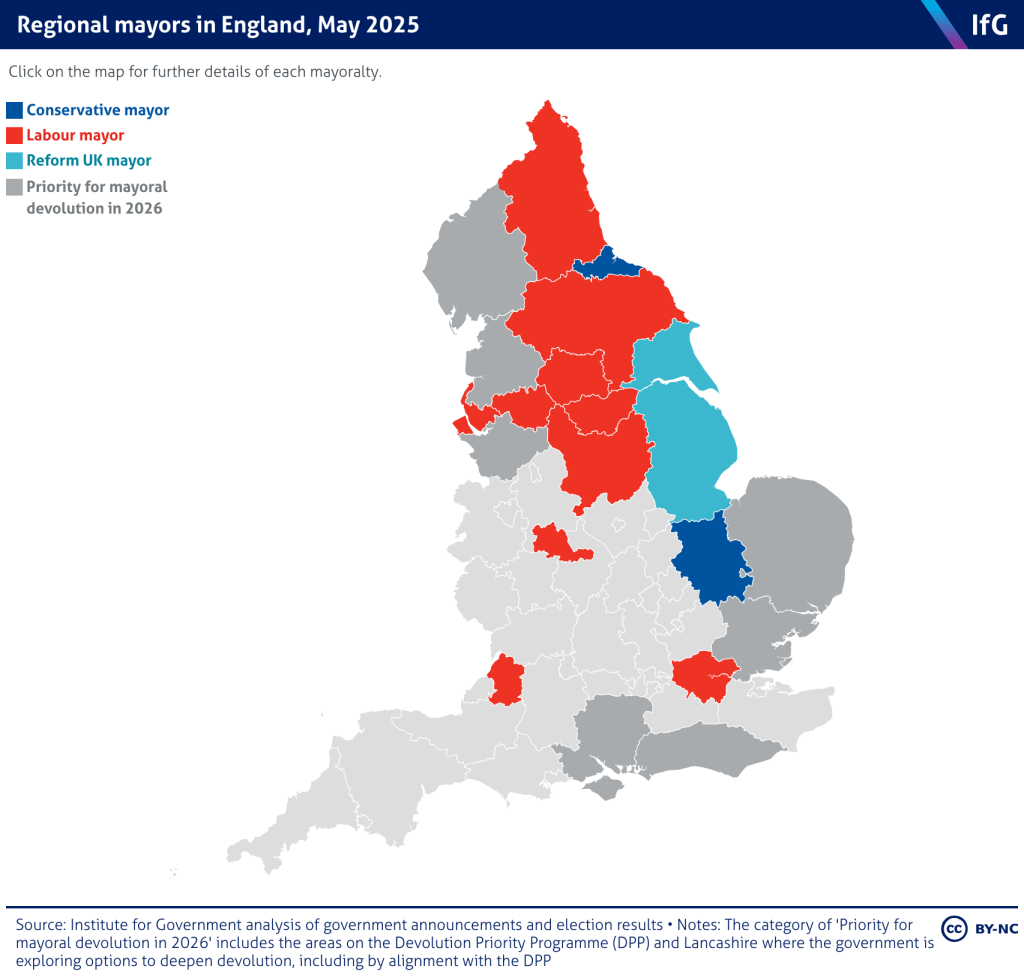
Jim McMahon OBE MP, Minister of State for Local Government and English Devolution, confirmed in February 2025 the areas that had joined the Devolution Priority Program. These areas, highlighted in grey in the map are in ongoing consultations with the government, with a view to deliver mayoral elections in these areas in May 2026, along with those areas already with a directly elected mayor (an interactive version of the map opens in a new tab).
Looking forwards
These developments are promising. All councils should have devolution deals that work for them, their local economies and their residents. After the 2026 MCAs come into being, there will be a significant devolution gap in the south and southwest of England, so the government must prioritise negotiating deals to these areas.
Where possible, the government should aim to use the current upper-tier boundaries to guide devolution deals: county councils and unitary authorities. This approach streamlines devolving powers and avoids the complexity of involving multiple lower-tier councils, which can lead to disagreements and gridlock. Devolution seeks to deliver more efficient local governance, so it should be built on existing structures. Upper-tier authorities are in the best position to provide this service and can focus on delivering results instead of navigating internal bureaucracy.
The Devolution Priority Programme engages those authorities that have sensible geography, in which devolution can be accelerated. The Government has expressed a preference that regions cover roughly 1.5 million people. Since many areas do not meet this threshold (for example Oxfordshire covers only 750,000 people), ministers should have discussions whether to use an existing boundary or instead, more ambitiously, create a CCA with neighbouring authorities, such as in the East Midlands CCA covering Derbyshire and Nottinghamshire.
While this approach creates a devolved region with a greater economic scale and capacity, it raises important questions regarding whether the broader geographies align with existing geographies and identities. Critics claimed that the East Midlands devolution deal risked combining two separate economies and geographies in Derbyshire and Nottinghamshire, with residents of both often looking north and south rather than to each other. Geographic and economic mismatches could hinder the effectiveness of policy and levelling-up targets.
What must Whitehall consider?
The government has made promising steps to accelerate devolution. In order to decide upon future devolution deals the government must treat each potential deal on a case-by-case basis, looking at regional capacity, existing collaboration between local authorities and local identities.
Geography: does the proposed region have a population size large enough to support strategic governance and deliver meaningful devolved functions? While the government suggested 1.5 million as a benchmark, it is important that proposed boundaries reflect economic areas and the delivery of public services such as healthcare and policing. Furthermore, the creation of a new deal should not hinder neighbouring areas from reaching their own deals, possibly through denying them a sufficient population size.
Governance: Have councils successfully worked together in the area? The region should demonstrate the ability to make decisions collectively and build strong local partnerships.
Identity: Does the region align with historic or existing boundaries? Proposed deals should have the support of the public and elected representatives. It should not be seen as a government-led movement, rather an organic and locally-led process, that reflects place-based identities.
Capacity: Can the proposed authority take on and deliver devolved powers effectively? There should be the administrative capacity and political will to manage new responsibilities as well as economic and social change.
In conclusion, devolution is not a “one size fits all” process. Encouraging steps have been made with the roll-out of regional mayors, however the government and local authorities can choose to go with a non-mayoral deal, if there is a weaker local appetite for devolution or limited experience with cross-council collaboration. What matters most is that devolution deals are tailored to the local environment, ensuring that any new deals are grounded in local administrative structure with genuine local support. If designed well, this can strengthen local economies, deliver value-for-money for taxpayers and create a new era of accountability in local government.
 A Local Lens